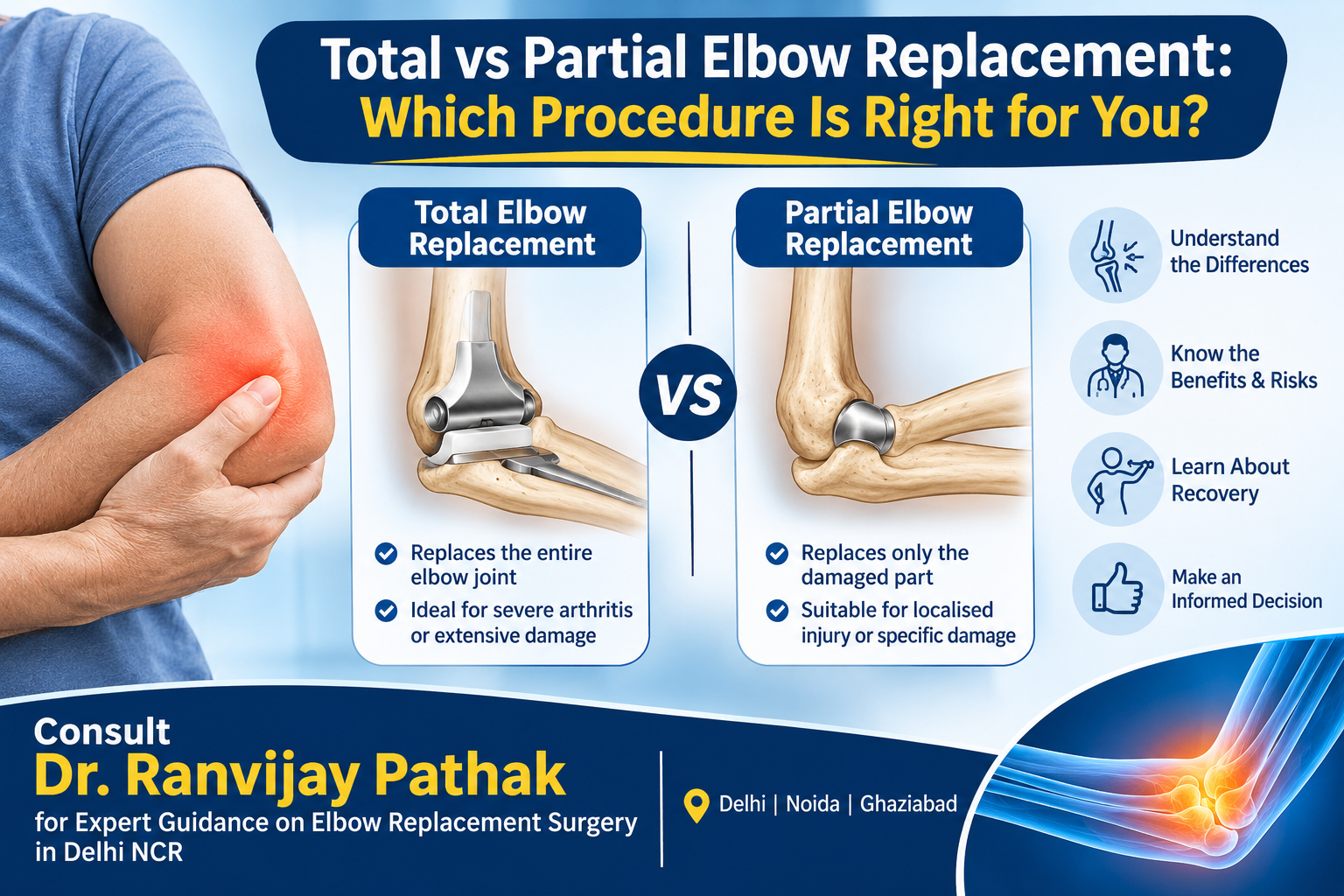
Total vs Partial Elbow Replacement: Which Procedure Is Right for You?
Elbow pain can significantly affect everyday activities, from lifting objects and getting dressed to eating, writing and performing routine household tasks. While occasional elbow discomfort may improve with rest, persistent pain, stiffness and restricted movement can indicate an underlying joint problem that requires medical attention.
Conditions such as severe osteoarthritis, rheumatoid arthritis, previous elbow injuries and complex fractures can gradually damage the elbow joint. When medications, physiotherapy and other non-surgical treatments fail to provide sufficient relief, elbow replacement surgery may become a treatment option.
However, not every patient requires the same surgical procedure. Depending on the extent of joint damage, an orthopaedic surgeon may recommend total elbow replacement or a partial elbow replacement.
Understanding the difference between these procedures can help patients make informed decisions about their treatment.
If you are considering elbow replacement surgery in Delhi NCR, Dr. Ranvijay Pathak can help assess your joint condition and discuss appropriate orthopaedic treatment options based on your individual needs.
What Is Elbow Replacement Surgery?
Elbow replacement surgery, medically known as elbow arthroplasty, is a surgical procedure in which damaged portions of the elbow joint are replaced with artificial components called prostheses.
The elbow is a complex joint formed by three bones:
- Humerus: The upper arm bone.
- Ulna: The forearm bone located on the little-finger side.
- Radius: The forearm bone located on the thumb side.
These bones work together to allow bending, straightening and rotation of the forearm.
When the cartilage covering the joint becomes severely damaged, the bones may rub against each other, causing pain, inflammation and stiffness.
During elbow joint replacement, the surgeon removes damaged joint surfaces and replaces them with artificial components designed to restore joint function and reduce discomfort.
There are two broad approaches:
- Total elbow replacement, which replaces the damaged joint surfaces on both sides of the joint.
- Partial elbow replacement, which replaces only a specific damaged portion of the elbow joint.
The choice depends on the patient’s diagnosis, bone condition, ligament stability, age, activity requirements and overall joint damage.
What Is Total Elbow Replacement?
Total elbow replacement, also called total elbow arthroplasty (TEA), is a surgical procedure in which the damaged joint surfaces of the upper arm bone and forearm bone are replaced with artificial components.
The artificial joint generally consists of metal components and a durable plastic bearing that work together to provide smooth movement.
In many cases, the artificial components are connected through a hinge mechanism to provide stability.
When Is Total Elbow Replacement Recommended?
A surgeon may recommend total elbow replacement when the damage affects a significant portion of the elbow joint.
Common conditions include:
- Severe osteoarthritis causing cartilage deterioration.
- Rheumatoid arthritis resulting in chronic joint inflammation.
- Post-traumatic arthritis following an old elbow fracture or injury.
- Complex elbow fractures that cannot be adequately reconstructed.
- Severe joint deformity and loss of movement.
- Persistent pain that does not improve with conservative treatment.
Patients experiencing significant pain, stiffness and difficulty performing everyday activities may benefit from an evaluation for total elbow arthroplasty.
Benefits of Total Elbow Replacement
Some potential benefits include:
- Significant reduction in chronic elbow pain.
- Improved ability to bend and straighten the arm.
- Better performance of routine daily activities.
- Improved joint stability in appropriately selected patients.
- Better overall quality of life.
However, patients should understand that total elbow replacement has specific activity limitations. Heavy lifting and activities that place excessive stress on the artificial joint may need to be avoided.
What Is Partial Elbow Replacement?
Partial elbow replacement involves replacing only a damaged portion of the elbow joint rather than replacing the entire joint.
It is generally considered in carefully selected patients whose joint damage is limited to a specific area.
One commonly used form is radial head replacement, in which the damaged radial head is replaced with an artificial implant.
This procedure may be recommended following certain severe radial head fractures or injuries that cannot be repaired effectively.
Other forms of partial elbow reconstruction may be considered depending on the location and nature of the damage.
When Is Partial Elbow Replacement Recommended?
Partial elbow replacement may be suitable when:
- Damage is restricted to a particular joint surface.
- A severe radial head fracture cannot be repaired.
- The remaining joint surfaces are relatively healthy.
- The surrounding ligaments can provide adequate stability.
- Preserving healthy bone and joint structures is possible.
The surgeon carefully evaluates the remaining cartilage, bones and ligaments before recommending this procedure.
Benefits of Partial Elbow Replacement
Potential benefits include:
- Preservation of healthy joint structures.
- Replacement of only the damaged portion.
- Potentially less extensive reconstruction in suitable cases.
- Restoration of stability following certain complex fractures.
- Preservation of more natural joint anatomy.
It is important to remember that partial replacement is not automatically better or less complicated than total replacement. The correct procedure depends on the underlying condition.
Total vs Partial Elbow Replacement: Key Differences
Although both procedures aim to improve elbow function and reduce pain, they differ in the amount of joint that is replaced.
| Comparison | Total elbow replacement | Partial elbow replacement |
|---|---|---|
| Surgical approach | Replaces major damaged joint surfaces | Replaces a specific damaged portion |
| Joint damage | Generally extensive | Generally localised |
| Implant | Usually replaces humeral and ulnar joint surfaces | Replaces a selected joint component |
| Common indication | Severe arthritis and extensive joint damage | Selected fractures and localised damage |
| Healthy structures | More joint surfaces are replaced | More natural joint structures are preserved |
| Activity restrictions | Often significant, particularly heavy lifting | Depend on the implant and remaining joint |
| Suitability | Depends on overall joint condition | Depends on local damage and joint stability |
Which procedure is better?
Neither procedure is universally better. Total elbow replacement may be more appropriate for patients with extensive joint destruction, while partial replacement may be considered when damage is limited to a specific portion of the elbow.
A detailed clinical examination and imaging assessment are necessary before making this decision.
Total vs Partial Elbow Replacement: Which Procedure Is Right for You?
Choosing between total and partial elbow replacement requires careful evaluation by an experienced orthopaedic surgeon.
Several factors influence the decision.
1. Extent of Joint Damage
The amount of cartilage and bone damage is one of the most important considerations.
If arthritis has affected most of the elbow joint, total elbow replacement may provide a more appropriate solution.
However, if only one portion of the joint is damaged, a partial replacement may be considered.
2. Patient’s Age and Activity Level
Age and lifestyle can influence surgical planning.
Younger patients generally have higher lifetime activity demands and may place more stress on an artificial joint. Older patients with severe arthritis or complex fractures may be suitable candidates for total elbow replacement.
However, age alone does not determine which procedure is appropriate.
3. Bone and Ligament Condition
The elbow joint depends on healthy bones, ligaments, tendons and surrounding muscles for stability.
If the surrounding ligaments are damaged or weakened, a partial replacement may not provide sufficient stability.
The surgeon evaluates these structures before selecting the appropriate implant.
4. Medical History
Medical conditions such as rheumatoid arthritis, osteoporosis, diabetes and previous elbow surgeries can influence treatment decisions.
Patients should share their complete medical history, current medications and previous treatment records with their surgeon.
5. Expected Functional Outcome
The patient’s daily requirements also matter.
Someone who needs to perform regular household activities may have different functional expectations from someone involved in physically demanding work.
The surgeon will explain the expected benefits and limitations of each procedure.
Common Conditions That May Require Elbow Replacement
Several medical conditions can cause severe elbow joint damage and may eventually require surgical intervention.
Osteoarthritis
Osteoarthritis develops when the protective cartilage gradually wears away. This can cause pain, stiffness, swelling and restricted movement.
Rheumatoid Arthritis
Rheumatoid arthritis is an autoimmune condition that causes chronic inflammation of the joint lining. Over time, inflammation can damage cartilage and bone, affecting elbow function.
Post-Traumatic Arthritis
Some patients develop arthritis years after an elbow fracture, dislocation or serious injury. Previous damage to the joint surfaces can result in persistent pain and reduced mobility.
Severe Elbow Fractures
Complex fractures involving the elbow joint may sometimes be difficult to reconstruct. In selected cases, joint replacement may be considered to restore function and reduce pain.
Early diagnosis and appropriate elbow arthritis treatment can help patients understand their options before joint damage becomes severe.
What Happens During Elbow Replacement Surgery?
The exact surgical technique depends on whether the patient requires total or partial elbow replacement.
Before surgery, the orthopaedic surgeon performs a detailed assessment, which may include:
- Physical examination of the elbow.
- X-rays to evaluate bone damage and joint alignment.
- CT scans in selected complex fracture cases.
- MRI scans when additional soft-tissue information is required.
- Blood tests and pre-anaesthesia evaluation.
During total elbow replacement, the surgeon accesses the damaged joint, prepares the humerus and ulna, and positions the artificial components.
In partial replacement, only the selected damaged portion is addressed.
The procedure is generally performed under anaesthesia. The duration and hospital stay vary depending on the complexity of the surgery and the patient’s medical condition.
Elbow Replacement Recovery: What Should Patients Expect?
Recovery after elbow replacement surgery is an important part of achieving a satisfactory outcome.
The recovery timeline varies depending on the procedure, implant type, bone quality, overall health and rehabilitation progress.
First Few Days After Surgery
Patients may experience some pain, swelling and stiffness around the operated elbow.
The medical team provides pain management, wound care and instructions regarding arm support.
Gentle finger and wrist movements may be encouraged to reduce stiffness and swelling.
First 2–6 Weeks
During this stage, patients gradually begin appropriate elbow movements as advised by their surgeon.
A physiotherapist may introduce gentle exercises to improve flexibility and prevent stiffness.
Patients should avoid lifting objects, pushing against resistance or performing movements that have not been approved by their treating surgeon.
6–12 Weeks
Many patients gradually progress with rehabilitation during this period.
Depending on healing and surgical instructions, physiotherapy may focus on:
- Improving elbow movement.
- Maintaining shoulder and wrist flexibility.
- Gradually restoring functional arm use.
- Improving muscle control.
- Performing daily activities safely.
Long-Term Recovery
Long-term recovery focuses on maintaining joint movement, protecting the implant and returning to appropriate daily activities.
Total elbow replacement patients may have permanent lifting restrictions to reduce stress on the implant. These restrictions vary according to the implant and surgeon’s recommendations.
Following the rehabilitation programme is essential for achieving the best possible functional outcome.
Risks and Complications of Elbow Replacement Surgery
Like every major surgical procedure, elbow replacement surgery carries certain risks.
Potential complications include:
- Infection: Infection can occur around the surgical wound or artificial implant.
- Nerve injury: Nearby nerves may be affected during surgery, occasionally causing numbness or weakness.
- Implant loosening: Artificial components may loosen over time.
- Joint stiffness: Some patients may continue experiencing restricted movement.
- Fractures: Bones surrounding the implant may fracture.
- Implant wear: Artificial components can gradually wear down with use.
- Revision surgery: Some patients may require another procedure if complications develop or the implant fails.
Not every patient experiences these complications. Proper patient selection, surgical planning, postoperative care and follow-up are important for reducing risks.
Elbow Replacement Cost in Ghaziabad and Delhi NCR
One of the common concerns among patients considering elbow replacement is the overall treatment cost.
The elbow replacement cost in Ghaziabad and other parts of Delhi NCR can vary considerably depending on several factors.
These include:
- Whether total or partial elbow replacement is required.
- Type and brand of artificial implant.
- Hospital facilities and room category.
- Surgeon’s professional fees.
- Anaesthesia and operation theatre charges.
- Preoperative investigations.
- Duration of hospitalisation.
- Physiotherapy and postoperative follow-up.
Total elbow replacement may involve different implant and surgical requirements compared with partial elbow replacement.
Patients searching for elbow replacement in Noida, Ghaziabad or Delhi should request a detailed treatment estimate from the hospital.
It is equally important to understand what is included in the quoted amount, including implant charges, medicines, investigations and rehabilitation.
Rather than selecting a hospital based only on cost, patients should consider the surgeon’s experience, surgical planning, implant quality and postoperative care.
Why Choose an Experienced Orthopaedic Surgeon for Elbow Replacement?
Elbow replacement is a specialised orthopaedic procedure that requires an understanding of joint anatomy, implant selection, ligament stability and rehabilitation.
Selecting an appropriate surgeon is important because the elbow is a complex joint responsible for several essential arm movements.
Dr. Ranvijay Pathak is an orthopaedic and joint replacement surgeon practising in the Delhi NCR region. His professional profile describes experience in joint replacement surgery, sports injury management, arthroscopy and musculoskeletal reconstruction.
Patients considering elbow replacement surgery in Delhi NCR can consult Dr. Ranvijay Pathak for an orthopaedic assessment and discussion of suitable treatment options.
An individual consultation can help patients understand:
- Whether total or partial elbow replacement may be appropriate.
- Whether non-surgical treatment options are still available.
- Which implant type may be suitable.
- Expected recovery and rehabilitation requirements.
- Potential risks and long-term activity restrictions.
The final treatment recommendation should always be based on the patient’s clinical examination, imaging findings and individual medical requirements.
When Should You Consult an Elbow Replacement Surgeon in Delhi?
Not every episode of elbow pain requires surgery. However, certain symptoms should not be ignored, particularly when they persist or gradually worsen.
Consider consulting an orthopaedic specialist if you experience:
- Persistent elbow pain that interferes with daily activities.
- Difficulty bending or straightening your arm.
- Swelling around the elbow joint.
- Pain during lifting or gripping.
- Stiffness after periods of rest.
- Repeated elbow injuries or previous fractures.
- Severe arthritis affecting arm movement.
Patients looking for an elbow replacement surgeon in Delhi, Noida or Ghaziabad should seek an evaluation before deciding on surgery.
Early assessment can help identify the underlying cause and determine whether medication, physiotherapy, other joint-preserving treatments or replacement surgery is appropriate.
Frequently Asked Questions (FAQs)
1. What is the main difference between total and partial elbow replacement?
Total elbow replacement involves replacing the major damaged joint surfaces of the humerus and ulna with artificial components. Partial elbow replacement involves replacing only a specific damaged portion, such as the radial head.
2. Is total elbow replacement better than partial elbow replacement?
Neither procedure is always better. Total replacement is generally considered for extensive joint damage, whereas partial replacement may be suitable for selected localised injuries. The decision depends on the patient’s joint condition.
3. How long does elbow replacement surgery take?
The duration depends on the type of replacement, severity of joint damage and complexity of the procedure. Your surgeon can provide a more accurate estimate after reviewing your investigations.
4. How long does it take to recover from elbow replacement surgery?
Initial recovery takes several weeks, while functional recovery may continue for several months. The exact timeline depends on the procedure, healing and rehabilitation progress.
5. How long does a total elbow replacement last?
Many elbow replacements function for 10 years or longer. However, implant lifespan varies depending on patient activity, implant design, bone quality and other factors. Some patients may eventually require revision surgery.
6. Can I lift heavy objects after total elbow replacement?
Heavy lifting is generally restricted after total elbow replacement because excessive stress can cause implant loosening or failure. Your surgeon will provide specific long-term weight restrictions.
7. What is the elbow replacement cost in Ghaziabad?
The cost depends on the type of replacement, implant, hospital, surgeon’s fees and rehabilitation requirements. A personalised estimate is best obtained after clinical evaluation.
8. Who should I consult for elbow replacement in Noida or Delhi NCR?
Patients can consult an experienced orthopaedic and joint replacement surgeon for an assessment. Dr. Ranvijay Pathak provides orthopaedic and joint replacement consultations in the Delhi NCR region.
Conclusion
Choosing between total and partial elbow replacement is an important decision that depends on the extent of joint damage, bone condition, ligament stability, medical history and functional requirements.
While total elbow arthroplasty may be appropriate for extensive joint damage, partial elbow replacement can help selected patients with localised injuries preserve more of their natural joint structures.
The right treatment approach should always be determined after a detailed orthopaedic assessment.
If persistent elbow pain, arthritis or an old injury is affecting your daily activities, consider consulting Dr. Ranvijay Pathak for an evaluation and guidance regarding appropriate elbow treatment options in Delhi NCR.
The goal of elbow replacement treatment is not simply to replace a damaged joint but to help patients achieve pain relief, better movement and improved everyday function.