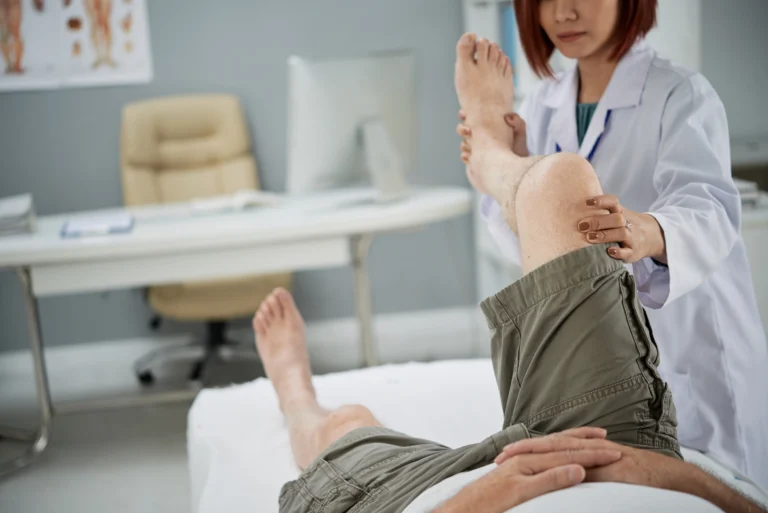

Best Nonsurgical Treatments for Knee Osteoarthritis
Knee pain can make even simple activities feel difficult. Walking to the market, climbing stairs, sitting on the floor, getting up from a chair or spending time with your family can become uncomfortable when knee arthritis starts affecting your daily life.
If you have been diagnosed with knee osteoarthritis, you may be wondering:
Can knee arthritis be treated without surgery?
In many cases, there are several nonsurgical treatment options that can help reduce pain, improve movement and support your ability to stay active. The right treatment, however, depends on the severity of arthritis, your symptoms, age, activity level, overall health and how your knee responds to previous treatment.
For patients in Ghaziabad, Indirapuram, Noida and the wider Delhi-NCR region, Dr. Ranvijay Pathak can evaluate your knee condition and help you understand which treatment approach may be appropriate for you.
The American Academy of Orthopaedic Surgeons (AAOS) recommends approaches such as exercise, strengthening, low-impact aerobic activity and self-management as important components of nonsurgical knee osteoarthritis care.
What Is Knee Osteoarthritis?
Knee osteoarthritis is a degenerative condition that affects the structures of the knee joint. Over time, the cartilage that helps the bones move smoothly can become damaged or thinner. This can lead to pain, stiffness and difficulty moving the knee.
Common symptoms include:
- Knee pain while walking
- Pain while climbing stairs
- Stiffness after sitting for a long time
- Difficulty squatting
- Swelling around the knee
- Reduced knee movement
- Cracking or grinding sounds
- Pain after prolonged standing
- Difficulty walking longer distances
The severity of symptoms can vary considerably between people.
Some people with early arthritis may experience occasional discomfort, while others may have persistent pain that interferes with work, sleep and everyday activities.
That is why treatment should be based on your symptoms and your knee condition—not simply your age or X-ray report.
Can Knee Osteoarthritis Be Treated Without Surgery?
Yes, many patients can initially be managed with nonsurgical treatment.
Nonsurgical treatment is generally focused on reducing pain, improving strength and mobility, supporting daily activities and helping patients remain active.
However, there is no single treatment that works for everyone.
Your orthopaedic specialist may recommend one treatment or a combination of approaches depending on your individual condition.
Some commonly considered nonsurgical treatments include:
- Exercise and strengthening
- Physiotherapy
- Weight management
- Activity modification
- Pain-relieving medicines
- Injections in selected patients
- Knee braces or supportive devices
- Regenerative treatments in appropriate cases
Let’s look at these options in more detail.
1. Exercise and Knee Strengthening
Exercise is one of the most important parts of managing knee osteoarthritis.
You may think that resting your painful knee is the best option. While temporary rest can sometimes be helpful during a flare-up, avoiding movement completely can lead to muscle weakness and reduced mobility.
Strengthening the muscles around your knee can help improve your ability to perform everyday activities.
Depending on your condition, exercises may include:
- Quadriceps strengthening
- Hamstring strengthening
- Leg raises
- Range-of-motion exercises
- Low-impact aerobic exercises
- Balance and neuromuscular exercises
The AAOS strongly recommends self-management, strengthening, low-impact aerobic exercise and physical activity for people with symptomatic knee osteoarthritis.
The key is choosing exercises that are appropriate for your knee.
If you are experiencing significant pain, avoid starting an intense exercise programme without professional guidance.
2. Physiotherapy
Physiotherapy can be particularly useful when knee pain is affecting your strength, flexibility or walking pattern.
A physiotherapist can assess how you move and create an exercise programme based on your individual needs.
Your programme may include:
- Muscle strengthening
- Stretching
- Range-of-motion exercises
- Balance training
- Walking or movement training
- Low-impact aerobic exercise
- Advice on modifying activities
Physiotherapy does not simply aim to reduce today’s pain. The broader goal is to help you become stronger and more confident in using your knee.
For many patients, consistent exercise and physiotherapy can become an important part of long-term arthritis management.
3. Weight Management
If you are overweight or have a higher body mass index, losing weight may be recommended as part of your knee arthritis treatment plan.
Why?
The knee experiences substantial mechanical load during everyday activities. Reducing excess body weight can reduce the load placed on the joint and may make movement easier.
The AAOS guideline suggests weight loss for patients with symptomatic knee osteoarthritis and a BMI of 25 or higher.
Weight management should not be approached as simply “losing weight to fix your knee.”
Instead, it should be viewed as one part of a broader strategy that may include:
- Appropriate exercise
- Strength training
- Balanced nutrition
- Better mobility
- Improved overall health
Even gradual, sustainable changes can be more practical than attempting extreme diets or exercise programmes.
4. Activity Modification
Having knee arthritis does not necessarily mean that you have to stop being active.
Instead, you may need to change how you perform certain activities.
For example, your doctor or physiotherapist may recommend reducing activities that repeatedly aggravate your knee while encouraging lower-impact alternatives.
Depending on your condition, activities such as swimming, cycling or controlled walking may be easier on the knees than high-impact activities.
You may also need to modify:
- How long you stand continuously
- How frequently you climb stairs
- Deep squatting
- Repeated kneeling
- High-impact exercise
- Activities that repeatedly trigger pain
The goal is not to stop moving.
The goal is to find a level and type of activity that your knee can tolerate.
5. Medicines for Pain and Inflammation
Medicines may sometimes be used to control knee osteoarthritis symptoms.
Depending on your health and medical history, a doctor may consider options such as topical or oral anti-inflammatory medicines or other pain-relieving medications.
However, medicines are not suitable for everyone.
Certain anti-inflammatory medicines may carry risks for people with particular heart, kidney, stomach or other medical conditions.
This is why you should not regularly take painkillers simply because they are available without a prescription.
Your doctor can consider:
- Your age
- Existing medical conditions
- Other medicines you take
- Your symptoms
- How long treatment may be required
The AAOS guideline includes NSAIDs among nonsurgical options for symptomatic knee osteoarthritis, while emphasizing that treatment decisions should be individualized.
6. Knee Injections
For some patients, injections may be considered when exercise, physiotherapy and other conservative measures do not provide sufficient relief.
One commonly used option is an intra-articular corticosteroid injection, which may provide short-term relief in appropriate patients.
AAOS guidance supports corticosteroid injections for short-term pain relief in selected patients.
Other injection-based treatments, such as platelet-rich plasma (PRP), may also be discussed depending on the individual situation.
However, not every injection is suitable for every patient, and evidence varies between different treatments.
For example, earlier AAOS evidence reviews found uncertainty or limited evidence for some injection approaches.
The important question should therefore be:
Which injection, if any, is appropriate for my knee—and what can I realistically expect from it?
7. Braces and Supportive Devices
A knee brace may be considered for some patients, particularly when knee alignment or instability contributes to symptoms.
Depending on the problem, an orthopaedic specialist may recommend a hinged brace or an unloading brace.
Some patients may also benefit from an assistive device such as a walking stick or other support.
These options are not necessary for everyone.
The purpose is to provide appropriate support when it can improve comfort, stability or mobility.
AAOS appropriate-use guidance includes knee braces and assistive devices among nonsurgical treatment options for selected patients.
8. Regenerative Treatment Options
Regenerative medicine has attracted considerable attention among patients looking for alternatives to surgery.
Treatments such as PRP and certain cell-based therapies are being studied for their potential role in managing knee osteoarthritis.
However, it is important to distinguish medical research from marketing claims.
No regenerative treatment should be presented as a guaranteed cure for arthritis or a guaranteed way to prevent knee replacement.
For example, AAOS appropriate-use criteria specifically note that growth-factor or stem-cell injections were outside the scope of that particular criteria document because of the available evidence.
If you are considering regenerative treatment, ask your doctor:
- What treatment is being recommended?
- Why is it appropriate for my condition?
- What evidence supports it?
- What benefits can realistically be expected?
- What are the potential risks?
- Are there alternative treatments I should consider?
A responsible treatment plan should be based on your individual knee condition rather than promises of a “permanent cure.”
Which Nonsurgical Treatment Is Best for You?
This is perhaps the most important question.
There is no universally “best” nonsurgical treatment for knee arthritis.
For one patient, physiotherapy and strengthening may be enough to significantly improve daily function.
Another patient may require medication, an injection or additional support.
Someone with more advanced arthritis may need a detailed discussion about whether nonsurgical treatment is still likely to provide meaningful relief.
This is why a proper orthopaedic evaluation is important.
Your doctor may consider:
The stage of your arthritis
Early, moderate and advanced osteoarthritis can require different approaches.
Your pain level
Pain that occurs occasionally is different from pain that interferes with sleep or everyday activities.
Your mobility
Your ability to walk, climb stairs, squat and perform daily tasks can help guide treatment decisions.
Your previous treatments
Your response to physiotherapy, medication or injections can provide useful information.
Your overall health
Other medical conditions and medications may affect which treatments are appropriate.
Your goals
Treatment should also consider what matters to you.
For example, an active working professional, a homemaker and a retired person may have very different daily requirements from their knees.
Can Nonsurgical Treatment Delay Knee Surgery?
For some patients, appropriate nonsurgical management may provide meaningful symptom relief and help them remain active without immediate surgery.
But it is important to set realistic expectations.
Nonsurgical treatment does not necessarily reverse established cartilage damage.
If arthritis becomes severe and pain and disability continue despite appropriate nonsurgical treatment, surgery may eventually need to be discussed.
AAOS guidance notes that when non-operative measures such as exercise and NSAIDs fail to provide adequate relief and patients continue to experience pain and difficulty with daily activities, surgical treatment may be considered.
The decision should never be based only on an X-ray.
It should consider your symptoms, functional limitations, examination findings, imaging and response to previous treatment.
When Should You See an Orthopaedic Specialist?
You should consider an evaluation if knee pain is becoming persistent or interfering with your normal routine.
Seek an assessment if you experience:
- Persistent knee pain
- Increasing stiffness
- Recurrent swelling
- Difficulty climbing stairs
- Difficulty walking
- Pain while standing
- Difficulty getting up from a chair
- Difficulty squatting
- Reduced knee movement
- Pain that is affecting your daily activities
Early evaluation can be useful because it gives you an opportunity to understand your condition and explore appropriate treatment options before symptoms become more limiting.
Seeing an orthopaedic specialist does not automatically mean you will need surgery.
The purpose of the consultation is to understand what is happening and determine the most suitable treatment pathway.
Knee Arthritis Treatment in Ghaziabad, Indirapuram and Noida
If you are searching for nonsurgical knee arthritis treatment in Ghaziabad, Indirapuram or Noida, Dr. Ranvijay Pathak can assess your symptoms and help you understand your treatment options.
Patients across Indirapuram, Ghaziabad, Noida and nearby Delhi-NCR areas may seek specialist care when knee pain begins affecting their mobility and quality of life.
Instead of continuing to manage knee pain on your own, an orthopaedic evaluation can help answer important questions:
How advanced is my arthritis?
Can my symptoms be managed without surgery?
Would physiotherapy or strengthening help?
Would an injection be appropriate?
Am I a candidate for any regenerative treatment?
When should surgery actually be considered?
Having clear answers can help you make a more informed decision about your knee.
Frequently Asked Questions
What is the best treatment for knee osteoarthritis without surgery?
There is no single best treatment for everyone. Exercise, strengthening, physiotherapy, weight management, activity modification and appropriate medication are commonly used. In selected patients, injections or other treatments may also be considered.
Can knee arthritis be treated permanently without surgery?
Nonsurgical treatment can help control symptoms and improve function, but it cannot guarantee permanent elimination of arthritis. Osteoarthritis is a degenerative joint condition, and treatment goals should be realistic.
Can walking help knee arthritis?
Appropriate physical activity can be beneficial for many people with knee osteoarthritis. However, the intensity and type of activity should match your symptoms and physical condition.
Is physiotherapy good for knee arthritis?
Yes. Strengthening, range-of-motion exercises and appropriate aerobic activity are important components of nonsurgical knee osteoarthritis management. AAOS gives a strong recommendation for exercise and strengthening approaches.
Are knee injections an alternative to surgery?
Injections may provide symptom relief for selected patients, but they are not necessarily a permanent alternative to surgery. Their suitability and expected benefit depend on the individual patient.
Can weight loss reduce knee pain?
For patients who are overweight, weight loss may help reduce the load on the knee and improve symptoms and function. AAOS suggests weight loss for symptomatic knee osteoarthritis patients with BMI ≥25.
Does everyone with knee arthritis need knee replacement?
No. Many patients can initially be managed with nonsurgical treatment. Knee replacement is generally considered when symptoms and functional limitations remain significant despite appropriate treatment and the overall clinical picture supports surgery.
Take the First Step Towards Better Knee Health
Living with knee arthritis does not mean you have to immediately choose surgery.
Depending on your condition, there may be several nonsurgical approaches that can help reduce pain, improve strength and support your mobility.
The most important step is to understand what is causing your knee pain and how advanced your arthritis is.
If you are experiencing persistent knee pain in Ghaziabad, Indirapuram, Noida or the surrounding Delhi-NCR region, consider consulting an orthopaedic specialist for an individual assessment.
Dr. Ranvijay Pathak can help you understand your knee condition and discuss suitable nonsurgical and surgical treatment options based on your individual needs.
Your treatment should be built around your knee—not around a one-size-fits-all solution.
Book a consultation to discuss your knee pain and explore appropriate treatment options.