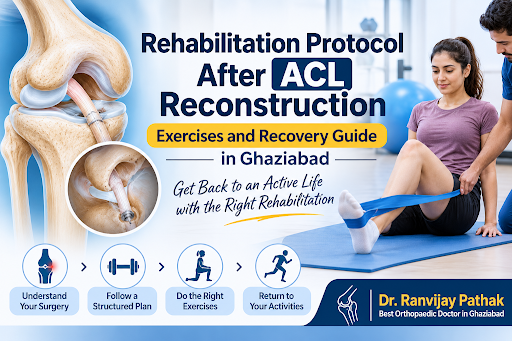
Rehabilitation Protocol After ACL Reconstruction: Exercises, Recovery Stages, and Advanced Surgical Options in Ghaziabad
An anterior cruciate ligament (ACL) injury can significantly affect knee stability, mobility, and the ability to participate in sports and everyday activities. The ACL is one of the major ligaments inside the knee joint. It helps control forward movement and rotation of the shin bone in relation to the thigh bone. When this ligament tears, a person may experience knee instability, swelling, pain, and difficulty performing activities that involve running, jumping, twisting, or sudden changes in direction.
ACL reconstruction is a commonly performed surgical procedure for patients with significant ligament injuries, particularly those who experience repeated knee instability or want to return to physically demanding activities. However, successful treatment does not end with surgery. A structured rehabilitation programme is essential for restoring knee movement, strength, balance, coordination, and confidence.
Modern ACL treatment also includes different surgical approaches and graft choices. These may include traditional ACL reconstruction, reconstruction with internal bracing, and newer synthetic ligament options such as JewelACL. The most appropriate approach depends on the patient’s injury, activity level, knee anatomy, and overall treatment goals.
This guide explains the rehabilitation protocol after ACL reconstruction, important recovery exercises, ACL reconstruction with internal bracing, what JewelACL is, how it compares with traditional ACL reconstruction, ACL surgery for sports persons, and how surgeons select an appropriate ACL graft.
What Is ACL Reconstruction Surgery?
ACL reconstruction is a surgical procedure in which a torn anterior cruciate ligament is replaced with a graft or, in selected techniques, a synthetic ligament implant. The purpose is to restore knee stability and help the patient return to daily activities, exercise, and sports.
The ACL may tear during activities involving sudden stopping, pivoting, landing awkwardly, or changing direction. Sports such as football, basketball, badminton, kabaddi, and skiing commonly involve movements that can place significant stress on the ligament. However, ACL injuries can also occur after falls, road accidents, or other traumatic incidents.
During traditional ACL reconstruction, the surgeon usually removes or clears the damaged ligament tissue and places a graft through tunnels created in the thigh bone and shin bone. The graft is secured using suitable fixation devices to provide stability while the body gradually incorporates and remodels the tissue.
The graft may come from the patient’s own body, known as an autograft, or from donor tissue, known as an allograft. Common autograft options include:
- Hamstring tendon graft
- Bone-patellar tendon-bone (BPTB) graft
- Quadriceps tendon graft
The choice of graft is an important part of surgical planning. Each option has advantages and limitations, and no single graft is ideal for every patient.
Why Is Rehabilitation Important After ACL Reconstruction?
Rehabilitation is one of the most important parts of ACL recovery. Even when surgery successfully restores the mechanical stability of the knee, the surrounding muscles and movement patterns may remain weak or altered.
After surgery, patients may experience reduced quadriceps strength, stiffness, swelling, difficulty bending or straightening the knee, and reduced balance. These issues can affect walking, climbing stairs, and returning to exercise.
A structured rehabilitation programme helps to:
- Restore knee extension and gradually improve bending.
- Reduce swelling and discomfort.
- Improve quadriceps, hamstring, and hip muscle strength.
- Restore balance and coordination.
- Improve walking and movement patterns.
- Develop control during running, jumping, and landing.
- Prepare the patient for a safe return to sports and other demanding activities.
Rehabilitation should be progressive. Starting high-intensity exercises too early may place unnecessary stress on the healing graft. On the other hand, avoiding movement and strengthening for too long can contribute to stiffness and muscle weakness.
The programme must be adjusted according to the surgical technique, graft type, associated meniscus or cartilage procedures, and the patient’s recovery.
Rehabilitation Protocol After ACL Reconstruction
The recovery process is generally divided into different phases. The following is a broad guide, not a fixed prescription for every patient. The treating surgeon and physiotherapist should decide when an individual can progress to the next stage.
Phase 1: Week 0–2 – Protection and Early Movement
The first two weeks focus on controlling swelling, protecting the reconstructed ligament, restoring knee extension, and gradually improving muscle activation.
Patients may experience swelling, discomfort, and difficulty walking during this stage. These symptoms are common after surgery, but they should be monitored.
Main rehabilitation goals:
- Control pain and swelling.
- Achieve full knee extension as advised.
- Gradually improve knee bending.
- Activate the quadriceps muscles.
- Begin safe walking with appropriate support.
- Protect the surgical site and graft fixation.
Common early exercises:
- Ankle Pumps: Move the ankle up and down repeatedly while lying or sitting. This encourages circulation and helps reduce the risk of blood clots.
- Quadriceps Sets: Keep the leg straight and gently tighten the thigh muscle by pressing the back of the knee towards the supporting surface. Hold briefly and relax.
- Heel Slides: Slowly slide the heel towards the body to bend the knee within the permitted range. Return to the starting position without forcing the movement.
- Straight Leg Raises: If the patient can maintain proper knee control without the knee bending, lift the straight leg gently and lower it slowly.
- Patellar Mobility Exercises: When permitted by the treating team, gentle kneecap movements may help maintain mobility.
Patients should not force knee bending or begin unsupported exercises without guidance. Weight-bearing instructions may differ depending on whether additional procedures, such as meniscus repair, were performed.
Phase 2: Weeks 2–6 – Improving Mobility and Muscle Strength
Once swelling begins to settle and the patient demonstrates better quadriceps control, rehabilitation gradually focuses on improving knee movement, walking, and lower-limb strength.
Main rehabilitation goals:
- Improve knee bending and maintain full extension.
- Develop better quadriceps activation.
- Improve walking technique.
- Strengthen the hip and lower-leg muscles.
- Gradually increase functional activity.
Common exercises:
- Stationary Cycling: A stationary bicycle may be introduced when sufficient knee movement is available and the physiotherapist approves it.
- Heel Raises: Stand with support and slowly raise the heels, then lower them under control.
- Mini Squats: Perform shallow squats within the permitted range while maintaining proper knee alignment.
- Hip Abduction: Lie on the side and raise the upper leg to strengthen the hip muscles.
- Bridging: Lie on the back with knees bent and lift the hips while keeping the movement controlled.
- Supported Weight Shifts: Gradually transfer body weight from one leg to the other while maintaining balance and control.
The patient should avoid twisting movements, sudden direction changes, deep squats, and uncontrolled loading during this stage unless specifically cleared.
Phase 3: Weeks 6–12 – Progressive Strengthening and Balance
This phase focuses on improving strength, stability, and control of the operated leg. Patients may gradually perform more challenging exercises as their knee function improves.
Main rehabilitation goals:
- Improve quadriceps and hamstring strength.
- Strengthen the hip and calf muscles.
- Improve single-leg balance.
- Develop controlled movement during daily activities.
- Improve coordination and neuromuscular control.
Common exercises:
- Step-Ups: Step onto a low platform and return slowly, maintaining proper knee alignment.
- Single-Leg Balance: Stand on the operated leg with support nearby, progressing to more challenging balance activities when appropriate.
- Controlled Lunges: Perform shallow lunges only when cleared, ensuring that the knee remains aligned with the foot.
- Leg Press: A physiotherapist may introduce controlled resistance within a suitable range.
- Bridges and Hip Strengthening: Progress resistance or repetitions as strength improves.
- Balance Training: Use controlled weight shifts and balance exercises to improve joint awareness.
Exercise quality is more important than the number of repetitions. The patient should avoid allowing the knee to collapse inward during squats, step-ups, or single-leg activities.
Phase 4: Months 3–6 – Advanced Strengthening and Functional Training
During this phase, the rehabilitation programme may progress towards more demanding strength and movement activities. The decision to introduce jogging, jumping, or agility exercises should be based on clinical assessment rather than simply the number of weeks after surgery.
Main rehabilitation goals:
- Improve lower-limb strength and endurance.
- Develop better single-leg control.
- Improve landing mechanics.
- Prepare the knee for running and sport-specific movements.
- Restore confidence in the operated leg.
Possible exercises include:
- Progressive resistance training.
- Single-leg Romanian deadlifts.
- Controlled lunges.
- Advanced step-up and step-down exercises.
- Balance and coordination drills.
- Running progression, when cleared.
- Basic jumping and landing drills, when appropriate.
A patient should not start running merely because three months have passed. Adequate strength, minimal swelling, good movement control, and satisfactory clinical assessment are important before progressing.
Phase 5: Months 6–12 – Return to Sports and Higher-Level Activities
The final rehabilitation phase focuses on preparing the patient for higher-demand activities. This is particularly important for athletes involved in football, basketball, badminton, cricket, and other sports that involve jumping, pivoting, sprinting, and rapid changes in direction.
Main rehabilitation goals:
- Restore strength and endurance.
- Improve speed, agility, and coordination.
- Develop safe jumping and landing techniques.
- Improve confidence during sport-specific movements.
- Complete return-to-sport testing before unrestricted participation.
Possible activities include:
- Progressive sprinting.
- Controlled acceleration and deceleration.
- Lateral movement drills.
- Agility training.
- Sport-specific drills.
- Progressive jumping and landing exercises.
- Controlled practice before full participation.
Returning to pivoting sports often takes nine months or longer. However, time alone does not establish readiness. Strength, functional testing, knee stability, movement quality, psychological readiness, and the demands of the sport must all be considered.
ACL Reconstruction With Internal Bracing: What Is It?
ACL reconstruction with internal bracing is an approach in which a reconstructed ACL graft is supported by an additional high-strength synthetic tape or suture-tape construct. This is commonly described as an internal brace or suture-tape augmentation.
The purpose is to provide additional support to the reconstructed ligament while the graft heals and undergoes biological remodelling.
In a conventional ACL reconstruction, the graft is secured inside the knee using fixation devices. With an internal brace technique, a strong tape is added alongside the graft and secured to the relevant bone attachment points. The tape is intended to act as a protective support rather than replace the biological graft.
How does internal bracing work?
The internal brace is positioned alongside the reconstructed ligament. It is designed to share some of the load placed on the graft during certain movements and provide additional support during the healing period.
Potential aims include:
- Providing additional mechanical support to the graft.
- Helping protect the reconstruction during early rehabilitation.
- Supporting the graft while biological healing takes place.
- Potentially reducing excessive strain on the reconstructed ligament.
However, internal bracing does not eliminate the possibility of graft failure or reinjury. It also does not mean that patients can skip rehabilitation or return to sports earlier without proper testing.
Is internal bracing better than traditional ACL reconstruction?
Not necessarily for every patient. Internal bracing is an additional surgical technique, and its suitability depends on the patient’s injury pattern, graft choice, activity demands, and the surgeon’s assessment.
Some research on synthetic augmentation techniques suggests potential benefits in selected outcomes, but evidence is still developing and results vary by technique and patient group. Internal bracing should therefore be considered a possible option rather than a guaranteed improvement over standard ACL reconstruction.
What Is Jewel ACL? How Does It Work?
Jewel ACL is a synthetic ligament device used as an option for ACL reconstruction. Unlike traditional reconstruction using a tendon harvested from the patient’s body, JewelACL is a manufactured polyester scaffold designed to function as a ligament substitute.
It is made from polyethylene terephthalate (PET), a type of polyester. Its woven structure is designed to allow tissue ingrowth. Over time, tissue can grow into the scaffold and contribute to the formation of a ligament-like structure.
The device may be used as a standalone synthetic ligament or in selected hybrid procedures involving a patient’s own tendon graft. The exact technique depends on the patient’s injury and the surgeon’s treatment plan.
How does Jewel ACL work?
The general process involves:
- Assessment of the ACL injury: The surgeon evaluates the tear, knee stability, associated injuries, and the patient’s activity requirements.
- Preparation of the knee: The surgeon performs the required arthroscopic steps and prepares the attachment points according to the selected technique.
- Placement of the synthetic scaffold: The JewelACL device is positioned to reconstruct the ligament and secured using the planned fixation method.
- Tissue integration: The scaffold’s open woven structure is designed to allow surrounding tissue to grow into it.
- Rehabilitation: The patient follows a structured rehabilitation programme to restore strength, movement, balance, and knee function.
Jewel ACL is different from internal bracing. Internal bracing generally supports a biological graft or repair with additional tape, whereas JewelACL is itself a synthetic ligament scaffold used for reconstruction.
Jewel ACL vs Traditional ACL Reconstruction
Both techniques aim to restore knee stability after an ACL injury, but they differ in the material used to reconstruct the ligament.
| Feature | Traditional ACL Reconstruction | Jewel ACL |
|---|---|---|
| Reconstruction material | Usually a tendon graft | Synthetic polyester scaffold |
| Donor-site harvesting | Required for autografts | Not required when used as a standalone implant |
| Tissue integration | Biological graft incorporates and remodels | Scaffold is designed to permit tissue ingrowth |
| Donor-site discomfort | Possible with tendon harvesting | Avoided with standalone use |
| Surgical approach | Established reconstruction techniques | Device-specific reconstruction technique |
| Evidence base | Extensive clinical experience and research | Growing but comparatively limited evidence |
| Suitability | Depends on patient and graft selection | Depends on patient selection and surgeon assessment |
Potential advantages of Jewel ACL
- A standalone synthetic option may avoid harvesting a tendon from the patient’s own body.
- It may avoid some donor-site problems associated with tendon harvesting.
- Its scaffold structure is designed to support tissue ingrowth.
- It offers an alternative reconstruction approach for selected patients.
Limitations and considerations
- Long-term evidence is less extensive than the evidence available for established autograft techniques.
- Synthetic implant-related complications and failure risks must be considered.
- Results from smaller studies cannot establish that the device is superior for every patient.
- Availability, regulatory status, cost, and the surgeon’s experience with the technique may influence treatment decisions.
Is Jewel ACL better than traditional ACL reconstruction?
There is no universal answer. JewelACL may offer advantages in selected situations, particularly where avoiding tendon harvesting is important. However, traditional autograft reconstruction remains a well-established option with a substantial clinical evidence base.
A prospective study published in 2025 compared JewelACL with a semitendinosus tendon autograft in 50 sports-active patients. The researchers reported similar results across several measured clinical scores, with earlier return to training and sport in the JewelACL group. However, the study involved a relatively small group and a limited follow-up period, so its findings should not be interpreted as proof that JewelACL is better for all patients.
A separate long-term study published in 2026 reported encouraging patient-reported outcomes after JewelACL reconstruction, but the researchers also identified important limitations, including loss to follow-up and the absence of standardised objective clinical testing and imaging.
The best approach is to compare the benefits, risks, available evidence, and suitability of each technique for the individual patient rather than selecting a procedure based only on the name of the implant.
ACL Reconstruction in Sports Persons
ACL injuries are common in sports that involve sudden stopping, pivoting, jumping, landing, and rapid changes in direction. Athletes participating in football, basketball, badminton, cricket, tennis, kabaddi, and similar activities may be at risk.
For a sports person, ACL reconstruction is not only about walking comfortably. The treatment goal may also include restoring the strength, speed, coordination, stability, and confidence required for competitive or recreational sports.
Why is ACL reconstruction important for some athletes?
A complete ACL tear can cause repeated episodes of knee instability, particularly during pivoting movements. Repeated instability may also increase the risk of additional damage to structures such as the meniscus.
For athletes who wish to return to high-demand sports and continue experiencing instability, reconstruction may be recommended after a detailed assessment. However, not every ACL tear automatically requires surgery. Treatment decisions depend on the patient’s symptoms, activity goals, associated injuries, and response to rehabilitation.
Important considerations for sports persons
- The type of sport and its physical demands.
- Whether the athlete is a professional, competitive, or recreational participant.
- The extent of the ACL injury.
- Whether the meniscus or cartilage is also damaged.
- The athlete’s age, strength, and overall physical condition.
- Previous knee injuries or surgeries.
- The athlete’s ability to complete structured rehabilitation.
Choosing the surgical technique for an athlete
Graft selection and surgical planning are particularly important for athletes because their knees may experience high forces during sprinting, jumping, landing, and pivoting.
The surgeon may consider hamstring, patellar tendon, or quadriceps tendon autografts. Selected patients may also be considered for additional procedures, such as lateral extra-articular tenodesis, to address rotational instability and reduce the risk of graft failure.
Internal bracing or a synthetic ligament option may also be discussed where appropriate. However, no technique can guarantee a return to the same sporting level or eliminate the possibility of another injury.
When can an athlete return to sports?
Return to sports should be gradual and based on recovery milestones. It should not be decided only by counting the months after surgery.
Before returning to unrestricted sports, an athlete may need to demonstrate:
- Full or near-full knee movement.
- No significant swelling or pain after activity.
- Good knee stability on clinical examination.
- Adequate quadriceps and hamstring strength.
- Satisfactory single-leg hop and functional test performance.
- Good landing, cutting, and movement mechanics.
- Confidence and psychological readiness.
- Successful completion of sport-specific rehabilitation.
The athlete should progress from basic running to controlled drills, non-contact practice, full practice, and finally competition, with clearance from the treating team.
Which ACL Graft Is Better?
Graft selection is one of the most important decisions during ACL reconstruction. The surgeon considers the patient’s age, activity level, sport, occupation, knee anatomy, previous injuries, and personal preferences.
There is no single graft that is best for everyone. The most appropriate option is the one that provides a suitable balance of stability, healing potential, donor-site effects, and functional recovery for the individual patient.
1. Hamstring Tendon Graft
The hamstring graft is commonly used in ACL reconstruction. It is usually prepared using one or more hamstring tendons taken from the inner side of the thigh.
Potential advantages:
- Avoids harvesting part of the patellar tendon.
- Usually causes less anterior knee pain than a patellar tendon graft.
- Provides a suitable graft option for many patients.
- Has a well-established history of use in ACL reconstruction.
Possible limitations:
- May cause some hamstring weakness.
- Can lead to discomfort or weakness at the tendon-harvest site.
- Graft size and quality may vary between individuals.
2. Bone-Patellar Tendon-Bone (BPTB) Graft
This graft uses the central portion of the patellar tendon along with small bone blocks from the kneecap and shin bone.
Potential advantages:
- Bone-to-bone healing at the fixation sites.
- A well-established option for active patients.
- Often considered in patients who participate in high-demand pivoting sports.
Possible limitations:
- Anterior knee pain may occur.
- Kneeling discomfort can be a concern.
- There is a risk of patellar tendon-related complications, including rare patellar fracture or tendon problems.
3. Quadriceps Tendon Graft
A quadriceps tendon graft is taken from the tendon above the kneecap. It may be used with or without a bone block.
Potential advantages:
- Provides a substantial graft option.
- Can be useful when hamstring or patellar tendon grafts are less suitable.
- May cause less kneeling discomfort than a patellar tendon graft in some patients.
Possible limitations:
- Temporary quadriceps weakness may occur.
- Recovery of thigh muscle strength requires structured rehabilitation.
- The suitability of the graft depends on the patient’s anatomy and surgical plan.
4. Synthetic Ligament Options Such as JewelACL
Synthetic ligament devices offer an alternative to conventional tendon grafts. JewelACL is one such option, designed to provide a synthetic scaffold for ACL reconstruction.
A standalone synthetic device may avoid tendon harvesting, but its benefits and limitations must be considered in light of the available clinical evidence, device-specific risks, and patient suitability.
So, Which ACL Graft Should You Choose?
The decision should be made after a detailed orthopaedic evaluation. A young athlete involved in pivoting sports may have different graft requirements from a recreational walker or someone who wants to return to routine daily activities.
The surgeon should discuss the expected benefits, possible complications, donor-site effects, rehabilitation requirements, and evidence for each suitable option.
Patients should avoid choosing a graft solely because it is described as newer, stronger, or faster. The surgical technique, graft fixation, rehabilitation quality, and individual patient factors all influence the final outcome.
Common Mistakes to Avoid During ACL Rehabilitation
Even after technically successful surgery, certain mistakes can delay recovery or increase the risk of complications.
Common mistakes include:
- Returning to running or sports too early.
- Ignoring swelling or increasing knee pain.
- Skipping physiotherapy sessions.
- Avoiding quadriceps strengthening.
- Performing deep squats or heavy exercises before clearance.
- Neglecting balance and single-leg control.
- Comparing recovery speed with another patient’s progress.
- Stopping rehabilitation once walking becomes comfortable.
Recovery should be guided by measurable improvements in strength, movement, stability, and function rather than by comparison with other patients.
How Long Does Recovery Take After ACL Reconstruction?
Recovery time varies from person to person. Many patients gradually return to routine activities over the first few months, while higher-demand activities and pivoting sports require a longer rehabilitation period.
| Recovery stage | General focus |
|---|---|
| First 2 weeks | Swelling control, knee extension, early muscle activation |
| Weeks 2–6 | Mobility, walking, and basic strengthening |
| Weeks 6–12 | Progressive strengthening and balance |
| Months 3–6 | Advanced strength and functional training |
| Months 6–9 | Running, agility, and sport-specific progression when cleared |
| Months 9–12 or longer | Consideration for unrestricted pivoting sports after testing |
These are broad stages, not guaranteed recovery deadlines. Additional procedures, graft type, complications, and individual progress can change the timeline.
When Should You Consult an Orthopaedic Specialist?
You should seek an orthopaedic assessment if you experience:
- Repeated knee giving-way episodes.
- Knee instability while walking or changing direction.
- Swelling after a sports injury.
- Difficulty fully straightening or bending the knee.
- Pain or instability that affects daily activities.
- Difficulty returning to sports after an ACL injury.
After surgery, contact your treating team if you develop increasing pain or swelling, fever, wound discharge, calf pain or swelling, or sudden breathing difficulty. These symptoms require prompt medical assessment; sudden breathing difficulty is an emergency.
Frequently Asked Questions
1. Is rehabilitation necessary after ACL reconstruction?
Yes. Rehabilitation is essential for restoring knee movement, strength, balance, coordination, and functional stability. Surgery alone cannot restore all the strength and movement control needed for daily activities or sports.
2. When can I start walking after ACL reconstruction?
Many patients begin walking with support soon after surgery, depending on the surgeon’s instructions and the type of procedure performed. Weight-bearing may be restricted if an associated meniscus repair or another procedure has been performed.
3. Can I return to sports after ACL reconstruction?
Many patients can return to sports after completing rehabilitation and passing appropriate clinical and functional assessments. The timing depends on strength, stability, movement quality, psychological readiness, and sport-specific requirements.
4. What is ACL reconstruction with internal bracing?
It is a technique in which a high-strength synthetic tape is added alongside the reconstructed graft to provide additional mechanical support. It does not replace the graft or eliminate the need for rehabilitation.
5. What is JewelACL?
JewelACL is a synthetic polyester scaffold used as an option for ACL reconstruction. Its woven structure is designed to allow tissue ingrowth. It may be used as a standalone synthetic ligament or in selected hybrid procedures.
6. Is JewelACL better than traditional ACL reconstruction?
Not for every patient. JewelACL may avoid tendon harvesting when used alone, but traditional autograft reconstruction has a more extensive clinical evidence base. The choice should be based on individual suitability and a discussion of the available evidence.
7. Which graft is best for ACL reconstruction?
Hamstring, patellar tendon, and quadriceps tendon grafts are established options. The best choice depends on the patient’s activity level, sport, anatomy, and treatment goals. No single graft is ideal for everyone.
8. How long does it take to return to sports after ACL reconstruction?
Returning to pivoting sports often takes nine months or longer. The decision should depend on functional testing, knee stability, strength, movement quality, and psychological readiness rather than time alone.
9. Can I avoid surgery after an ACL tear?
Some patients can manage an ACL injury without surgery through structured rehabilitation and activity modification. However, patients with repeated instability, associated injuries, or a need to return to demanding pivoting sports may benefit from surgical evaluation.
Consult Dr. Ranvijay Pathak for ACL Treatment Guidance in Ghaziabad
Choosing the right treatment for an ACL injury involves more than selecting a surgical technique. A complete treatment plan should consider the extent of the ligament injury, associated knee damage, the patient’s activity goals, graft suitability, surgical options, and a structured rehabilitation programme.
Patients looking for ACL treatment in Ghaziabad can consult an orthopaedic specialist to understand their diagnosis and discuss suitable treatment options, including traditional ACL reconstruction, reconstruction with internal bracing, and selected synthetic ligament approaches such as JewelACL.
Dr. Ranvijay Pathak can assess the patient’s knee condition and help explain the available treatment and rehabilitation options based on individual clinical findings.
If you have experienced an ACL injury or are planning to return to sports after knee surgery, seek a proper orthopaedic evaluation before beginning demanding exercises or resuming sports activities.