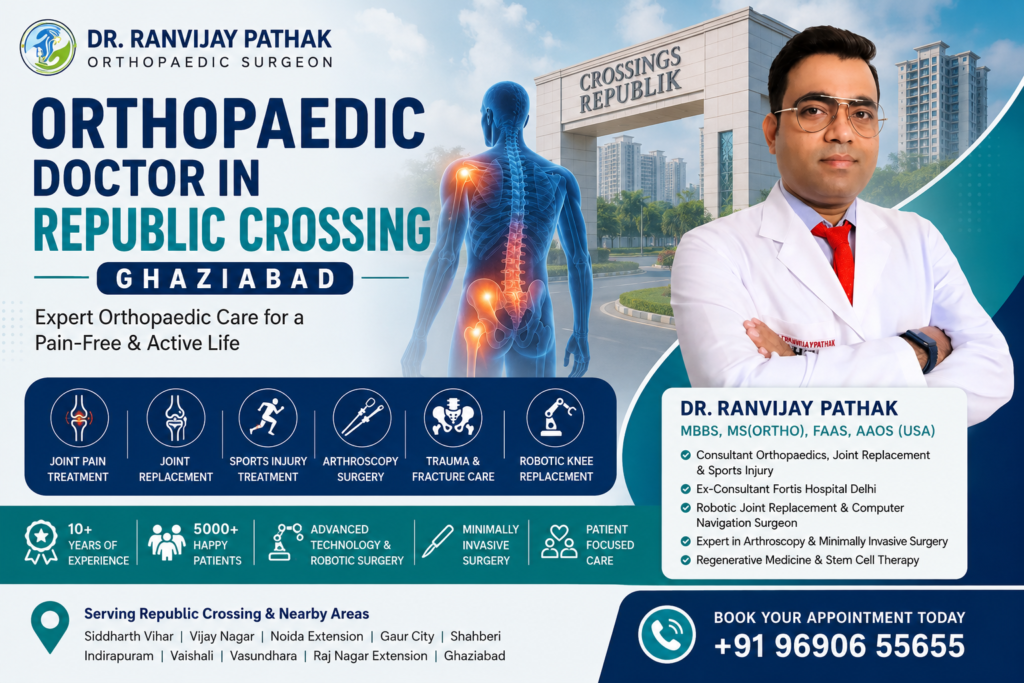
If joint pain, a sports injury, or a nagging backache has been slowing you down, you don’t need to travel across Ghaziabad or into Delhi-NCR to see a specialist. Dr. Ranvijay Pratap Pathak — MBBS, MS (Orthopaedics), FAAS, AAOS (USA) — brings more than a decade of orthopaedic surgical experience to residents of Crossings Republik and the surrounding communities, including Siddharth Vihar, Vijay Nagar, and Noida Extension. Whether you searched for an “orthopaedic doctor near me,” a “knee specialist near me,” or a “bone doctor near me,” you’ll find hospital-grade expertise right in your neighbourhood.
From everyday knee and shoulder pain to advanced robotic joint replacement and arthroscopic sports injury repair, Dr. Pathak’s practice is built around one idea: accurate diagnosis, honest treatment planning, and a recovery path that respects your time and your life.
Book a consultation today and take the first step toward moving without pain.
📍 Serving Republic Crossing, Siddharth Vihar, Vijay Nagar, Noida Extension, Gaur City, Shahberi, Indirapuram, and greater Ghaziabad.
Why Choose Dr. Ranvijay Pathak
Choosing the right orthopaedic surgeon is one of the most important healthcare decisions you’ll make. Here’s why families across Republic Crossing trust Dr. Pathak:
- 10+ Years of Focused Orthopaedic Experience — A career built on treating joint, bone, and sports-related conditions with consistent, measurable outcomes.
- Advanced Orthopaedic Care — From conservative management to complex reconstructive surgery, treatment is tailored to the individual, not a one-size-fits-all protocol.
- Robotic Joint Replacement — Computer-assisted precision for knee and hip replacement, aimed at better implant alignment and faster functional recovery.
- Sports Injury Expertise — Care for athletes and active individuals dealing with ligament tears, ACL injuries, and overuse conditions.
- Arthroscopy Specialist — Keyhole surgical techniques that reduce scarring, pain, and downtime compared to open procedures.
- Minimally Invasive Surgery — Smaller incisions, less tissue disruption, and quicker return to daily activity wherever clinically appropriate.
- Patient-Centric Treatment — Every treatment plan begins with listening. Dr. Pathak explains conditions and options in plain language before recommending a path forward.
- Modern Diagnostics — Digital imaging and clinical assessment tools that support accurate, timely diagnosis.
- Personalized Care Plans — Treatment decisions factor in your age, activity level, occupation, and long-term goals — not just the X-ray.
- Ex-Consultant, Fortis Hospital — Hospital-grade clinical training brought into an accessible, patient-first practice.
Comprehensive Orthopaedic Services
Dr. Pathak’s Republic Crossing-area practice covers the full spectrum of bone, joint, and musculoskeletal care.
General Orthopaedics Routine and complex bone and joint concerns, including diagnosis of chronic pain, mobility issues, and post-injury complications.
Joint Pain Evaluation and management of pain in the knees, hips, shoulders, and other joints, whether caused by wear-and-tear, injury, or inflammatory conditions.
Knee Pain From early-stage arthritis to ligament damage, knee pain is assessed thoroughly before deciding between physiotherapy, injections, or surgical intervention.
Hip Pain Hip pain can stem from arthritis, fractures, or biomechanical issues — each requiring a different treatment strategy, which Dr. Pathak identifies through detailed clinical evaluation.
Shoulder Pain Rotator cuff issues, frozen shoulder, and instability are addressed with a combination of rehabilitation and, when needed, arthroscopic correction.
Back Pain Mechanical and degenerative back pain is managed with a focus on identifying root cause rather than only treating symptoms.
Neck Pain Cervical spine discomfort linked to posture, injury, or degeneration is evaluated with attention to long-term spinal health.
Sports Injury Active individuals and athletes receive injury-specific care designed to support safe, complete return to sport.
ACL Injury Anterior cruciate ligament tears are assessed for severity and treated through reconstruction when surgery is the right call.
Ligament Tear Partial and complete ligament injuries across the knee, ankle, and shoulder are managed with both non-surgical and surgical options.
Meniscus Injury Meniscal tears are treated with repair or partial removal techniques aimed at preserving as much natural knee function as possible.
Arthroscopy Minimally invasive, camera-guided surgery used for diagnosis and treatment of joint conditions with smaller incisions and quicker recovery.
Fracture Care Prompt, accurate treatment of broken bones — from simple fractures to complex trauma cases.
Trauma Surgery Emergency and planned surgical management of serious musculoskeletal injuries.
Hip Replacement Total and partial hip replacement for patients with advanced arthritis or hip joint damage.
Knee Replacement Total and partial knee replacement designed to restore mobility and reduce chronic joint pain.
Robotic Knee Replacement Robotic-assisted surgical planning for improved implant positioning and joint alignment.
Shoulder Replacement Surgical restoration of shoulder function for patients with severe joint damage or arthritis.
Regenerative Medicine Biological treatment approaches that support the body’s own healing processes for certain joint and soft-tissue conditions.
Stem Cell Therapy Regenerative treatment options considered for appropriate candidates as part of a broader orthopaedic treatment plan.
Signs You Should Visit an Orthopaedic Doctor
Don’t wait for pain to become unbearable. Consider a consultation if you experience:
- Joint pain that persists for more than a few weeks
- Swelling, stiffness, or reduced range of motion in a joint
- A popping, locking, or giving-way sensation in the knee
- Pain that worsens with activity or weight-bearing
- Difficulty climbing stairs, walking, or standing for long periods
- A sports or accident-related injury that hasn’t improved with rest
- Chronic back or neck pain affecting daily function
- Visible deformity, bruising, or inability to move a limb after injury
- Numbness, tingling, or weakness radiating from the spine or joints
- Pain that disturbs sleep or limits routine activities
Conditions We Treat
| Category | Conditions |
| Joint Disorders | Osteoarthritis, Rheumatoid Arthritis, Frozen Shoulder |
| Sports Injuries | ACL/PCL Tears, Meniscus Tears, Rotator Cuff Injuries |
| Trauma | Fractures, Dislocations, Soft Tissue Injuries |
| Degenerative Conditions | Cervical & Lumbar Spondylosis, Disc Issues |
| Post-Surgical Needs | Joint Replacement Follow-Up, Revision Surgery Evaluation |
| Pediatric & Growth-Related | Growing Pains, Minor Bone Deformities |
Advanced Technology Used
Dr. Pathak’s practice integrates modern orthopaedic technology to improve diagnostic accuracy and surgical outcomes:
- Digital Diagnosis — High-resolution imaging for precise assessment
- Computer Navigation — Assisted surgical planning for improved accuracy
- Robotic Surgery — Robotic-assisted joint replacement for better alignment
- Minimally Invasive Procedures — Reduced-incision techniques across multiple treatments
- Arthroscopy — Camera-guided keyhole surgery for joint conditions
- Regenerative Therapy — Biological treatment options for select patients
Benefits of Early Orthopaedic Treatment
Delaying treatment for joint or bone issues often leads to more complex problems. Early consultation offers:
- Faster Recovery — Early-stage conditions typically respond better to conservative treatment
- Lower Risk of Complications — Untreated injuries can worsen or cause secondary damage
- Reduced Need for Major Surgery — Timely intervention can sometimes avoid or delay joint replacement
- Better Long-Term Mobility — Early correction protects joint function over time
- Cost-Effective Care — Addressing problems early is generally less resource-intensive than treating advanced complications
Why Republic Crossing Residents Choose Us
Republic Crossing (Crossings Republik) has grown into one of Ghaziabad’s most established residential hubs, and residents increasingly want quality orthopaedic care without a long commute. Here’s what makes this practice a preferred choice locally:
- Easy Accessibility — Convenient for patients across Crossings Republik and neighbouring sectors
- Proximity to Nearby Hospitals — Coordinated care when hospital-based treatment is required
- Quick Appointments — Reduced wait times for consultations and follow-ups
- Advanced Care Standards — Hospital-trained expertise delivered in an accessible setting
- Modern Facilities — Clean, well-equipped clinical environment
- A Trusted, Experienced Surgeon — A decade-plus track record treating the local community
Areas We Also Serve
In addition to Republic Crossing, Dr. Pathak’s orthopaedic practice regularly welcomes patients from:
- Siddharth Vihar
- Vijay Nagar
- Noida Extension
- Gaur City
- Shahberi
- Indirapuram
- Vaishali
- Vasundhara
- Raj Nagar Extension
- Ghaziabad (city-wide)
Wherever you’re located in this corridor, quality orthopaedic care is within easy reach.
Patient Journey
1. Consultation Your visit begins with a detailed discussion of your symptoms, medical history, and lifestyle to understand the full picture.
2. Diagnosis Clinical examination is combined with appropriate imaging or diagnostic tests to identify the exact cause of your condition.
3. Treatment Plan A personalized plan is created — ranging from physiotherapy and medication to minimally invasive or surgical options — based on your specific needs.
4. Recovery Post-treatment guidance, pain management, and rehabilitation support to help you regain function safely.
5. Follow-Up Ongoing monitoring ensures your recovery stays on track and any concerns are addressed promptly.
Frequently Asked Questions
1. Who is the best orthopaedic doctor near Republic Crossing? Dr. Ranvijay Pratap Pathak is a well-regarded orthopaedic surgeon serving Republic Crossing and surrounding Ghaziabad communities. With over ten years of clinical experience and a background as an ex-consultant at Fortis Hospital, he specializes in joint replacement, sports injuries, arthroscopy, and robotic knee surgery. Patients are evaluated individually, with treatment plans built around their specific condition rather than a generic protocol. His approach combines modern diagnostic tools with clear, honest communication, which is why many residents in Crossings Republik, Siddharth Vihar, and Vijay Nagar prefer consulting him for both routine and complex orthopaedic concerns.
2. What conditions does an orthopaedic doctor treat? An orthopaedic doctor treats conditions affecting bones, joints, muscles, ligaments, and tendons. This includes arthritis, fractures, sports injuries like ACL tears and meniscus damage, chronic back and neck pain, shoulder problems such as frozen shoulder or rotator cuff tears, and post-traumatic injuries. Orthopaedic care also extends to joint replacement surgery for advanced arthritis, arthroscopic procedures for minimally invasive diagnosis and repair, and regenerative treatments for certain soft-tissue conditions. If pain or reduced mobility is affecting your daily life, an orthopaedic specialist can identify the underlying cause and recommend an appropriate treatment path.
3. Is robotic knee replacement better than traditional knee replacement? Robotic-assisted knee replacement uses computer navigation to help the surgeon achieve more precise implant positioning and joint alignment compared to conventional techniques. This can translate into better joint mechanics and, for many patients, a smoother recovery. However, “better” depends on individual factors like bone quality, joint deformity, and overall health. Traditional knee replacement remains a well-established, effective option for many patients. Dr. Pathak evaluates each case individually to recommend whether robotic or conventional replacement is the more suitable choice for your specific knee condition and lifestyle needs.
4. When should I see a doctor for knee pain? You should see an orthopaedic doctor if knee pain lasts more than two to three weeks, worsens with activity, causes swelling, or limits your ability to walk or climb stairs. Sudden injuries accompanied by a popping sound, instability, or inability to bear weight also warrant prompt evaluation. Ignoring persistent knee pain can allow underlying issues — such as ligament damage or early arthritis — to progress further. Early assessment allows for more conservative treatment options and can often prevent the need for more invasive intervention later.
5. What is arthroscopy and how does it help? Arthroscopy is a minimally invasive surgical technique that uses a small camera and specialized instruments inserted through tiny incisions to diagnose and treat joint problems. It’s commonly used for knee, shoulder, and ankle conditions, including ligament tears, meniscus damage, and cartilage issues. Compared to traditional open surgery, arthroscopy typically involves smaller scars, less tissue disruption, reduced post-operative pain, and a faster return to normal activity. Dr. Pathak uses arthroscopic techniques where clinically appropriate, ensuring patients benefit from precise treatment with a less invasive recovery process.
6. Do you treat sports injuries for young athletes? Yes, sports injury care is one of Dr. Pathak’s core areas of focus. Young athletes are particularly prone to ligament injuries, overuse conditions, and growth-related musculoskeletal issues. Treatment considers not just the injury itself but the athlete’s long-term development, aiming for safe, complete recovery and return to sport. This includes evaluation of ACL and meniscus injuries, sprains, and stress-related conditions, with treatment plans that balance timely healing with protecting future joint health — an important consideration for younger, still-developing patients.
7. What should I expect during my first orthopaedic consultation? Your first visit typically includes a detailed discussion about your symptoms, medical history, and daily activity levels, followed by a physical examination. Depending on your condition, imaging such as X-rays may be recommended to support diagnosis. Dr. Pathak explains findings in clear, understandable terms and discusses realistic treatment options — whether that’s physiotherapy, medication, minimally invasive procedures, or surgery. The goal of the first consultation is to give you an accurate picture of your condition and a clear next step, without unnecessary tests or pressure toward a particular treatment.
8. Can joint pain be treated without surgery? Yes, many joint conditions respond well to non-surgical treatment, especially when addressed early. Options can include physiotherapy, activity modification, medication, and in some cases regenerative treatments. Surgery is generally considered when conservative measures haven’t provided sufficient relief, or when structural damage — such as a complete ligament tear or advanced joint degeneration — requires surgical correction. Dr. Pathak’s approach prioritizes the least invasive effective option first, reserving surgical intervention for cases where it offers a clear, meaningful benefit to the patient.
9. How long is recovery after knee replacement surgery? Recovery timelines vary by patient, but many individuals begin walking with support within a day or two after surgery, with physiotherapy starting early to support mobility. Most patients see substantial improvement in pain and function within six to twelve weeks, though full recovery and muscle strengthening can take several months. Robotic-assisted techniques, where used, may support a smoother early recovery due to improved implant alignment. Dr. Pathak provides a structured post-surgical and follow-up plan to help patients recover safely and regain independence as efficiently as possible.
10. Do you accept walk-in patients or is appointment booking required? While walk-ins may be accommodated depending on clinic schedule, booking an appointment in advance is recommended to minimize wait times and ensure adequate consultation time. This is especially useful for patients traveling from Republic Crossing, Siddharth Vihar, or nearby areas who want to plan their visit efficiently. Appointments can typically be scheduled by phone or through the clinic’s website. Booking ahead also allows the clinical team to review any prior reports or referrals before your visit, making the consultation more productive.
11. How do I find a good orthopaedic doctor near me in Republic Crossing? When searching for an “orthopaedic doctor near me,” look beyond proximity alone — check the surgeon’s qualifications, years of clinical experience, and areas of specialization. Dr. Ranvijay Pratap Pathak holds an MS in Orthopaedics along with AAOS (USA) recognition, over a decade of experience, and prior consultant experience at Fortis Hospital, making him a strong local option for residents of Republic Crossing, Crossings Republik, Siddharth Vihar, and Vijay Nagar. Beyond credentials, a good local orthopaedic doctor should offer accessible appointment scheduling, modern diagnostic tools, and a treatment approach tailored to your specific condition rather than a generic plan.